
How are Anthropic, Intercom, Stripe, and Persona are Experimenting with Pricing in the AI Era
Insights from Dealops on B2B SaaS Pricing in the AI Era.

Old SaaS seat-based playbooks are breaking.
Value creation in the AI era is fundamentally different, and our methods for capturing and selling that value must change with it.
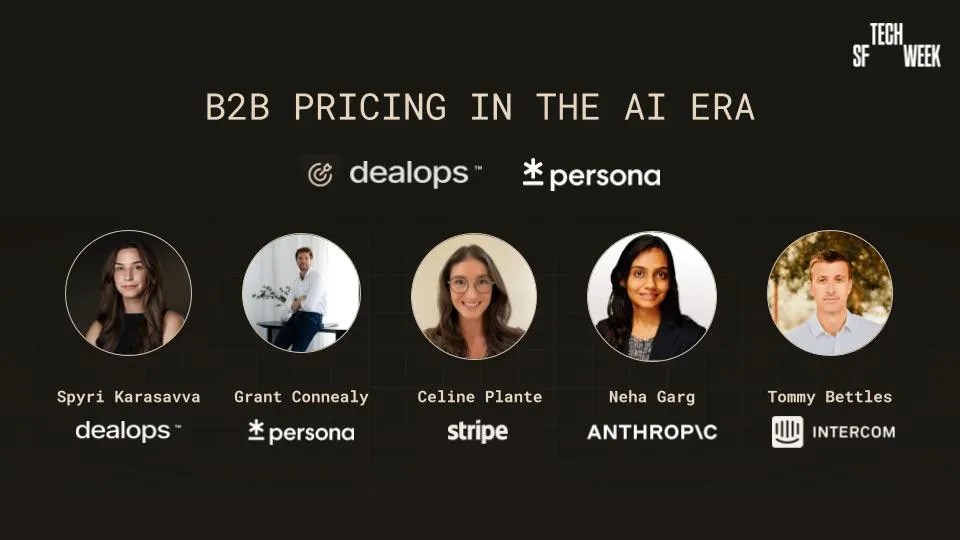
As part of SF Tech Week, Dealops co-hosted a panel at the Persona office alongside pricing leaders from Anthropic, Intercom, and Stripe to discuss how companies have taken to evolve their pricing strategies:
Grant Connealy, Finance, Corporate Development, and GTM at Persona
Celine Plante, Finance and Strategy Lead at Stripe
Tommy Bettles, VP of FP&A at Intercom
More than 700 people signed up, and among the max capacity of 120+ attendees, we welcomed finance and GTM operators, founders, and product builders.
These being the questions that keep GTM and finance teams up at night:
How do you price your product when the value of AI is still a moving target?
How do you experiment with pricing without slowing down your your sales cycle and confusing customers?
How do you balance pricing agility with setting up processes and systems to standardize some of your pricing logic?
Here’s what we learned from an hour of candid conversation about what’s actually working.
The Old Playbook Is Breaking
For the last decade, pricing in SaaS was almost easy. You’d set per-seat pricing, maybe review it annually, and move on. The marginal cost of serving an incremental user was effectively zero, so each seat meant more profit.
But AI flipped that equation.
AI’s marginal costs can be wildly variable, from compute, to token generation, to model inference. Meanwhile, the concept of a “seat” no longer represents the value an AI product delivers. It’s becoming a structural paradox where the better your AI gets at replacing human work, the fewer seats your customers need. If you’re pricing per seat, then increasing product performance could actually shrink your revenue base.
This reality is forcing the fastest-growing companies to rethink how they charge for their products going forward.
Celine Plante, Finance and Strategy Lead at Stripe, shared a stat from their recent survey:
67% of hyper-growth companies have changed their pricing model three or more times in just the past two years.
No one in the room was surprised, as that’s exactly why they signed up for the discussion. Frequent pricing changes has become the reality for each of the four panelists on stage, and it’s increasingly the norm for any AI startup today.
Companies are realizing that treating pricing as a back-office review means missing a key lever for growth. The best finance teams now monitor pricing weekly, responding to shifting consumption patterns, competitive moves, and evolving customer expectations.
New Models On The Table
Credit-based, usage-based, per-API-calls, per-workflow, and outcome-based structures are only the start, and teams at Intercom, Anthropic, Persona, and Stripe have all been deep in pricing experimentation.
“Our goal is to be flexible enough to never lose a deal due to pricing.” — Grant Connealy, Finance, Corporate Development, and GTM Lead at Persona
Grant and the Persona team have tried seat-based pricing for some of their products in the past, but found it wasn’t resonating with customers. They currently charge a fixed platform fee, then layer on AI-driven checks priced per verification. To make this work, they’ve built a tight feedback loop with their post-sales and solutions engineering teams, channeling customer pricing insights directly to the finance team. An internal group quantifies work across various metrics (engineering hours, discrete metrics like number of screens, unique steps), and that data collection enables ongoing pricing adjustments.
Intercom took a different path when they launched their AI Agent Fin with the still quite nascent outcome-based pricing. The pay-per-resolution model has turned Intercom into one of the shining examples of operationalizing outcome-based pricing at scale.
The Messiness of Operational Reality
Outcome-based and consumption-based pricing sound perfect in theory. In practice, they create real operational challenges.
“For us it was very, very important to anchor on what that outcome was, and be extremely transparent.” — Tommy Bettles, VP of FP&A at Intercom
To start, defining the correct metric is arguably the most difficult step because it fundamentally shifts how value is tracked and communicated. Tommy warned that transparency is non-negotiable. Without it, clients who are conceptually aligned with value-based pricing still experience “bill shock” when they receive their first invoice, killing any chance of long-term adoption.
Intercom has now explicitly defined a “resolution” in two ways: when a customer confirms their issue is solved, or when the exchange ends without further escalation. That clarity became the foundation of successful adoption and scale with their users.
But what if you don’t have clear outcomes?
Not every company can define outcomes as neatly as Intercom does with a “resolution.” If you can’t align on clear outcomes yet, go consumption-based or hybrid.
Persona went with usage-based pricing per verification. Stripe blends payment processing with recurring fees. Anthropic has implemented a flexible hybrid model that combines commitments, pure usage, and value-based tiers. Meanwhile, Intercom layered their AI Agent outcome-based pricing structure on top of their traditional seats-based model.
“I think we are a little bit early on the outcome based pricing side. It is still not articulate enough for us to say, ‘your ROI will increase by 20% so you pay us 10%.’ We’re still not that clear. It’s not quantifiable.” — Neha Garg, Head of GTM Finance & Strategy at Anthropic
Neha’s perspective crystallized a shared experience. The difficulty in defining a static “outcome” in a quickly evolving AI market is precisely why consumption and hybrid models are the pragmatic starting point, whether you’re at the infrastructure layer like Anthropic or the application layer like Intercom and Persona.
For Anthropic, each new model release shifts entire cost structure and customer expectations. Their flexible hybrid approach lowers the barrier to entry, creates natural product segmentation, and allows quick adaptation. It’s exactly why Grant and the Persona team focused on building tight feedback loops to adjust pricing with increased learning.
Flexibility can be powerful, but it quickly turns into friction if your buyers can’t make sense of it.
Enabling customers to actually understand the model
The best pricing model still fails if it confuses your buyers. Explaining ROI clearly helps prevent drawn-out back-and-forths that kill momentum in the sales cycle. It’s especially important as buyers are still trying to figure out how to approach this post seats-based world.
High-performing teams are creating enablement resources that make it easy for reps to guide customers through complex pricing conversations. These might look like:
Slides explaining what a “credit” means and how it breaks down into different components
Charts that compare multiple options with the specific tradeoffs
Documentation defining what counts as a “resolution” in various scenarios
When customers understand how they’re paying for the value they’re receiving, confidence goes up, friction drops, and deals close faster.
Balancing predictability with customer alignment
Even after you align on the components that go into your value prop and pricing, you’ll still need to solve for predictability for both you and your customers. A pure usage model can be too volatile, especially with how quickly AI products are still evolving, making it difficult for customers to forecast spend and for companies to plan.
“The reasoning behind the shift to hybrid model is really to have predictability on the recurring revenue side from a customer perspective, being able to forecast your budgets.” — Celine Plante, Finance & Strategy Lead at Stripe
This is where creative deal structures come in.
Intercom had introduced “bucketing” to address this. Customers purchase an annual commitment of AI resolutions, which are then drawn down throughout the year. It achieves both goals of budget predictability for customers and revenue security for Intercom. And as an incentive, larger commitments earn larger per-resolution discounts.
This is in line with what Grant and the Persona team are doing. They have implemented platform fees combined with usage commitments that secure predictability while maintaining flexibility.
And given Stripe has hundreds of SKUs across its product suite, their team gives self-serve startups as simple pricing as possible while maintaining flexibility at the enterprise level to align as much as possible to how their different customers want to buy.
Across each of the four panelists, the common thread is that pricing models are no longer static decisions but living systems that evolve with a number of factors. Everyone on the panel freely admits that they haven’t gotten to the perfect set of answers yet.
The Real Takeaway: Get Comfortable with Change
“Honestly, we’re flying the plane while building it.” — Neha Garg at Anthropic
Whether you’re one of the market-defining AI infrastructure leaders like Anthropic or a scaling AI startup, there isn’t a ‘right’ model that you can lean on for too long.
What you should do instead is get really comfortable with change and constant experimentation. Treat pricing in your org like a muscle you flex constantly, a few times a week if not daily.
This won’t be easy. It will challenge your current teams and processes including sales enablement (how do you train reps on pricing that changes weekly), your systems (can it handle the complexity and iteration speed), and your operations (can finance keep up with the changes).
But that’s the reality Neha described at Anthropic. They’re adjusting pricing with every model release, learning what resonates with customers, and adapting quickly. Grant at Persona has focused on tightening their feedback loops between post-sales, solutions engineering, and finance to enable rapid iteration.
Perfect pricing models do not exist today. The most innovative companies are building out systems and processes that enable fast, disciplined, and repeatable experimentation.
Not Sure How to Start?
If nimble pricing and quoting is a top of mind topic for you and your team, shoot us a note! It’s what we think about day in and day out here at Dealops. We’re helping customers who are:
Shifting between usage-based, outcome-based, or other hybrid structures without breaking their existing systems and infrastructure
Designing experiments to track and measure what works, testing new pricing strategies across segments and geos
Empowering reps to have the right conversations around pricing ROI with customer-facing assets and guided-selling
📨 We love talking about pricing. If you want to jam on your GTM challenges, reach out at spyri@dealops.com to chat!
Let’s make pricing make sense. Join our newsletter for real-world GTM stories, frameworks, and lessons from Dealops. Subscribe to get the next post straight to your inbox.